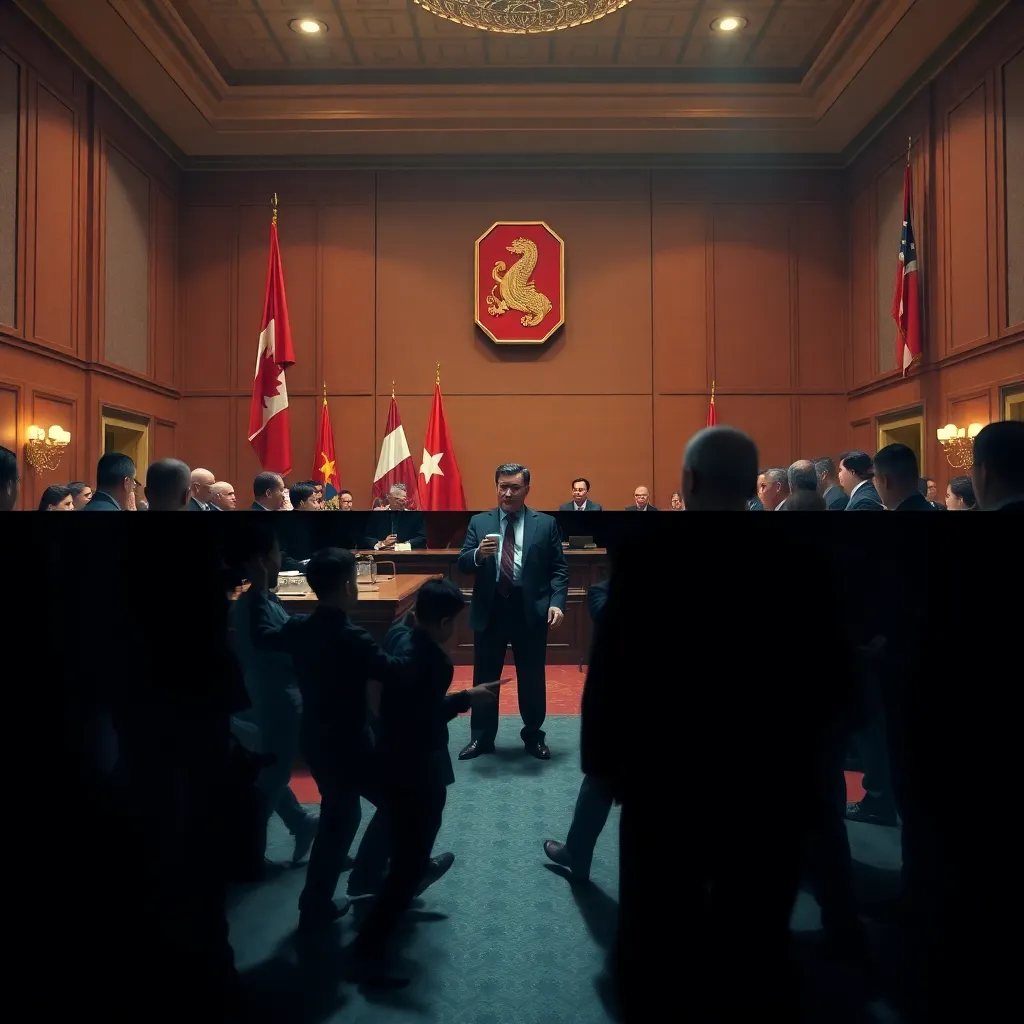
When Diplomacy Meets Detention: An Absurd Tale of International Relations and Youth Justice
Toronto, Canada – In a world where international diplomacy dances awkwardly with local justice, strange tales unfold that could only be described as absurd. Picture this: a high-stakes meeting in Beijing aimed at reviving China’s lagging economy while, back in Canada, a diplomatic minister is left in the dark about it all. And as if this international confusion wasn’t enough, news breaks from a youth detention center where officers are allegedly acting as referees in prison fights, raising eyebrows and questions about the state of youth justice.
The Great Canadian Diplomatic Mystery
Just when you thought the world was getting too serious, Canada’s Minister of Foreign Affairs made headlines not for a grand deal, but for not being contacted about a crucial meeting concerning the global economy. This meeting, which aims to revive China’s economy amid a trade war with the U.S., has left many scratching their heads. One can’t help but wonder: is this a diplomatic oversight or a deliberate act of international mischief?
In a press conference that felt more like a scene from a sitcom, the Minister stated, “I woke up this morning, had my coffee, and realized that nobody bothered to tell me about the meeting. I mean, am I not important enough to be in the loop?” The audience erupted in laughter, but the real question lingers: how does one manage to miss an invitation to a meeting that could reshape global trade?
Referees in a Youth Detention Center: The New Normal?
While Canada’s foreign affairs are being overshadowed by missed invitations, a scandal is brewing closer to home. Reports have surfaced from a youth detention center where officers allegedly acted as referees in fights among detainees. Yes, you read that right. Instead of maintaining order, these officers reportedly stood by, whistle in hand, like sports referees at a high school football game.
One unnamed source from within the center stated, “It’s like watching a very unprofessional version of ‘Fight Club’ – except it’s very real, and there’s no Brad Pitt to make it glamorous.” The Royal College of Psychiatrists has expressed deep concern over this bizarre situation, warning that such negligence could put children and young people at risk, which raises the question: where is the oversight?
A Diplomatic Circus and Justice Gone Awry
As the world turns, it seems like a circus where the clowns are diplomats and the lions are the youth in detention. With the Minister of Foreign Affairs left out of the loop on international discussions, one can only speculate what sort of diplomatic juggler would allow such a thing. It’s as if the Ministry is playing a game of telephone, where the message gets lost somewhere between “Let’s save the economy” and “Oops, I forgot to tell you.”
Meanwhile, in the realm of youth justice, the idea of officers refereeing fights in detention is almost comical if it weren’t so tragic. Imagine the scene: officers shouting “Foul!” while kids grapple on the ground, completely ignoring the fact that they should be preventing such altercations in the first place. This is not a new reality show; it’s a devastating indictment of a system that seems to have lost its way.
The Intersection of Economy and Justice
Now, juxtapose these two stories: a failing economy and a failing justice system. As China’s leaders convene to discuss economic strategies to combat the trade war with the U.S., Canada’s leaders are grappling with how to ensure that its youth are treated with dignity and respect.
The irony is thick. While one country focuses on international trade and economic recovery, another grapples with the very foundation of its social contract – treating its youth fairly. The question then becomes: can economic recovery happen when the very fabric of justice is fraying?
A Call to Action
As discussions around the globe continue, it’s crucial to remember that the youth of today are the leaders of tomorrow. If they are caught in a system where violence is tolerated, how can we expect them to rise and help us tackle economic challenges?
In a bold move, child advocates have taken to social media, tweeting hashtags like #JusticeForYouth and #RefereeNotFighters, urging both the Canadian government and international leaders to prioritize youth justice and mental health. They argue that investing in rehabilitation and mental health support is not just an ethical imperative but also a long-term economic strategy. After all, a society that protects its young is a society that thrives.
Conclusion: Laughter in the Face of Absurdity
In this age of absurdity, where international diplomacy meets local injustice, laughter is indeed the best medicine. While we may chuckle at the idea of a diplomatic minister being left out of a crucial meeting or the absurdity of detention officers acting as fight referees, we must also recognize the serious implications behind these stories.
As we watch the drama unfold on the world stage, let’s hope for a resolution that prioritizes both economic revival and justice reform. Because as ridiculous as it may seem, the fate of our future leaders – and the global economy – might just depend on it.
So, as we navigate through this circus, let’s keep our eyes on the prize: a fair, just, and economically sound future for all – one where nobody gets left out of the loop, and where youth aren’t just players in a fight, but champions in their own right.