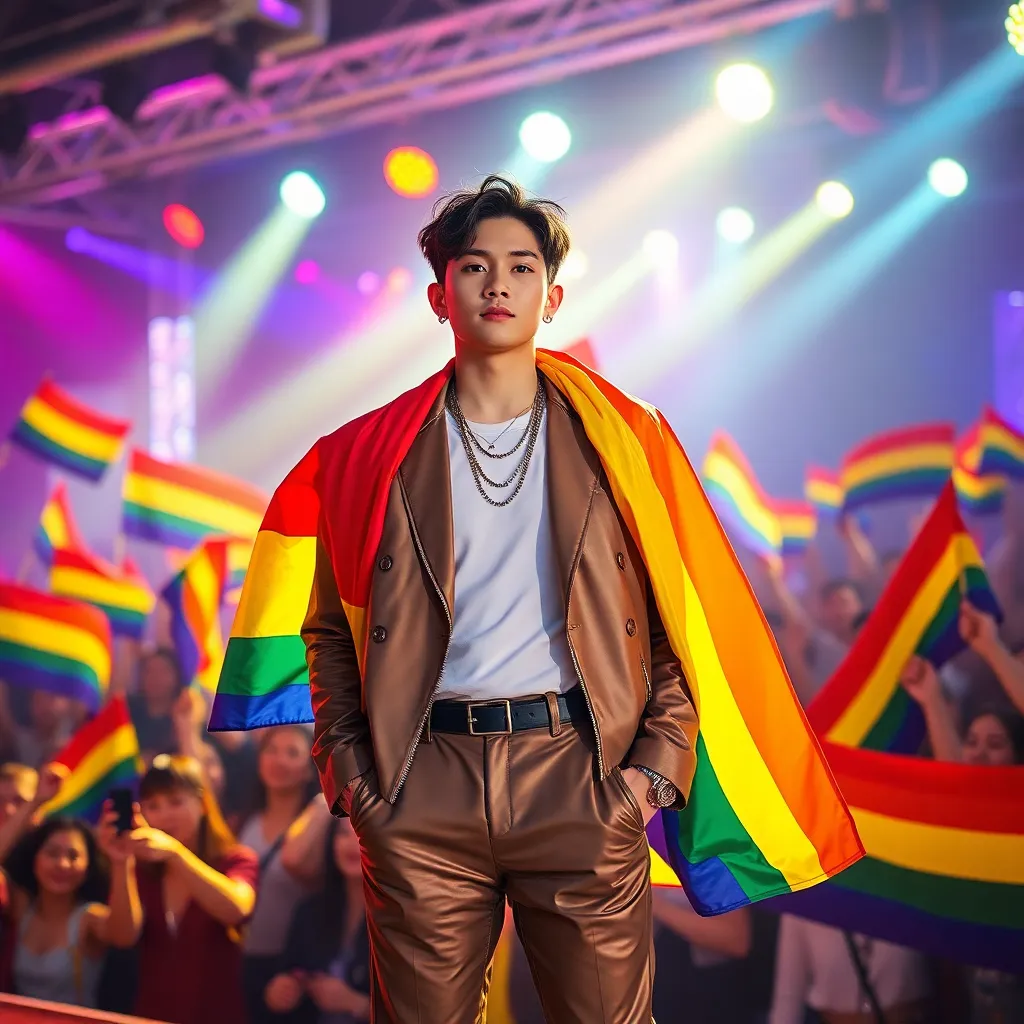
K-Pop’s Bold New Era: A Rainbow Revolution Amidst Political Chaos
Seoul, South Korea
In a world where politics and pop culture are increasingly intertwined, K-Pop is taking center stage not just for its catchy tunes and dazzling choreography, but for a new wave of boldness that could forever change the entertainment landscape. Amidst political turmoil and calls for reform in various sectors, the K-Pop industry is experiencing a unique moment of reflection and revolution, led by none other than the rising star, Bain.
A Star is Born
Bain, a member of the wildly popular group “Neon Vibes,” recently made headlines after coming out as gay in a heartfelt social media post. “It’s time to embrace who I am and inspire others to do the same,” Bain declared, sending shockwaves through the conservative fabric of South Korean society. This unprecedented move not only shines a light on the LGBTQ+ community in a country where such discussions have been largely taboo, but it has also ignited conversations about acceptance and representation in K-Pop.
“Bain’s courage is monumental,” said Min-Ji Park, a cultural critic based in Seoul. “K-Pop has always been a space for expression and creativity, yet LGBTQ+ representation has been lacking. Bain is a breath of fresh air, and I believe this could be a turning point for many artists to follow suit.”
The Perfect Storm of Politics and Pop
While Bain’s announcement has been met with both applause and controversy, it comes at a time when the political landscape in South Korea is anything but stable. Recent calls from various factions for reform have been met with mixed reactions from the public. The prime minister recently described the benefits system as “broken,” hinting at a need for significant changes. Meanwhile, party leadership is reportedly twisting arms to push through an initial vote on a controversial spending plan, raising eyebrows and questions about transparency.
Could the K-Pop industry, often seen as a glittering distraction, actually be the catalyst for broader social change? “The juxtaposition of Bain’s coming out against the backdrop of political chaos creates a fascinating narrative,” argues Jin Soo, a sociology professor at Seoul National University. “It’s as if the artists are saying, ‘If we can embrace our true selves, why can’t our leaders do the same?”
Chants of Change
In another corner of the cultural landscape, the rap duo Bob Vylan has taken a more aggressive stance, recently live-streaming a performance that called for “death” to military forces amid ongoing international tensions. Their chants resonated with a younger generation disillusioned with traditional political rhetoric. The juxtaposition of Bain’s heartfelt message with Bob Vylan’s fiery rhetoric highlights the diverse ways artists are addressing societal issues.
As protests gain momentum and activists are taken into custody for actions like spraying paint on planes, it seems the message is clear: the youth are demanding change—whether through the power of pop or the intensity of punk.
A New Wave of Representation
As K-Pop continues to gain global influence, Bain’s coming out could serve as a pivotal moment for LGBTQ+ representation not just in South Korea, but worldwide. Following Bain’s lead, other artists have begun to explore their identities more openly, with whispers of more announcements to come.
At a recent concert, fans were treated to a surprise message from Bain, who took a moment to address the crowd. “To anyone who feels different or alone, know that it’s okay to be yourself. Let’s create a world where we can all live authentically—together!” The audience erupted in applause, some even waving rainbow flags.
The Future is Bright
As the Pyramid Stage at the legendary Glastonbury Festival features artists like the Kaiser Chiefs, who opened the show, the spotlight is on how music can transcend boundaries and inspire social change. The world is waiting to see how Bain’s courage might influence other K-Pop artists, as well as the political landscape in South Korea and beyond.
In the coming weeks, as tensions rise and political debates heat up, will artists like Bain and Bob Vylan continue to pave the way for a new era of expression? One thing is certain: the fusion of music and activism is more potent than ever, and the pop culture landscape is ready for a rainbow revolution.
As society grapples with identity, representation, and the complexities of modern governance, K-Pop stands at the forefront, ready to lead the charge into a more inclusive future.